
Community Briefing Note 06 – Is the passenger door driving dangerous speed exemptions?
METRONET on Swan Ferry Expansion
Date: 9 September 2026
Author: Damien Smith
The issue
PTA’s Development Application finally gives us a General Arrangement of the ferry actually being built. And it exposes a surprisingly mundane potential bottleneck: the passenger door.
The published business case was built around a 20-minute service, alongside assurances that “all activities can continue with adjustments.”
At existing speed limits, PTA is now talking about roughly a 30-minute service. To get closer to 25 minutes it needs speed exemptions.
PTA presents those exemptions as providing a faster and more reliable service.
But there is another possibility.
The vessel, terminal, charging system and route were substantially locked in before basic operating questions such as passenger exchange, turning and vessel rotations had been worked through properly. The extra speed is now being used to claw back time from an over-optimistic timetable that was never properly engineered in the first place.
Less service improvement, more operational workaround for a design-process failure.
And the cost of that workaround gets transferred elsewhere: recreational water users get much faster ferries and the river gets damaging wake.
How quickly can 100 passengers get through one door?
The new ferry carries up to 100 passengers, including people with bicycles, prams and wheelchairs.
Looking at the General Arrangement, there is effectively one practical passenger stream for routine boarding and alighting.
First people get off. Then people get on.
There is another passenger access point aft, but it is separated from the primary boarding point. Using both simultaneously requires both passenger streams to be safely supervised, and the ferry has only two crew.
For my simulation I have assumed 15 effective passenger movements per minute, consistent with measured single-lane passenger throughput reported in the US Transportation Research Board’s TCRP Research Report 238, Quantitative Procedures for Designing and Operating Ferry Services.[2]
The arithmetic gets interesting very quickly.
If 40 people get off at Matilda Bay and another 40 get on, that is 80 passenger movements.
At 15 per minute, that takes about 5.3 minutes.
At 50 off and 50 on, it takes about 6.7 minutes.
And passengers aren’t particles in a computer model.
Eventually Nana pauses in the doorway. Someone has a bicycle. Someone is manoeuvring a wheelchair or pram. One person stops and everyone behind them stops too.
FIGURE 1 — PTA vessel passenger flow
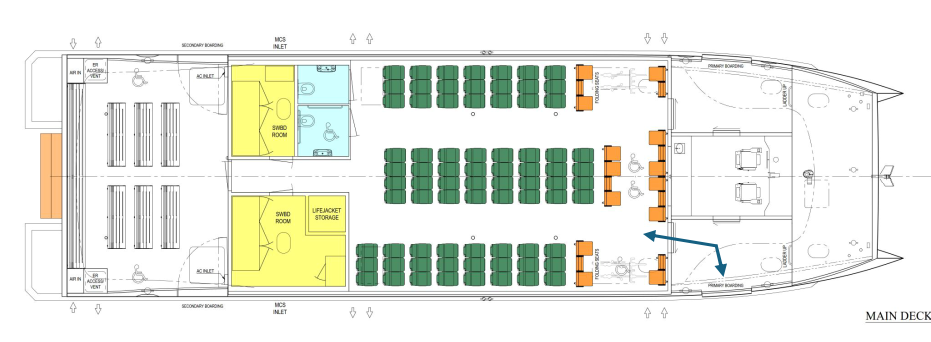
Passenger flow overlaid on the published PTA General Arrangement, showing the practical boarding and internal circulation path.
FIGURE 2 — Alternative vessel passenger flow
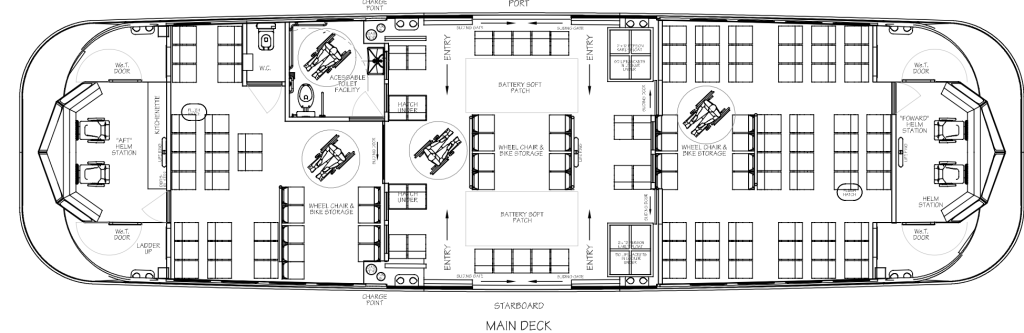
Alternative vessel arrangement: two adjacent passenger access points that can be supervised from one location, feeding through wide internal openings so passengers can disperse quickly through the vessel.
What happens when people actually turn up?
I have now put explicit passenger loading into my SimPy model of PTA’s published 30-minute operating case.
The result is fairly stark.
With low passenger turnover, the timetable just works. Add significant numbers of passengers and it starts to break.
At 40 off and 40 on at Matilda Bay, delay progressively accumulates, reaching about 22 minutes by the end of the operating day.
At 50 off and 50 on, maximum delay grows to roughly 49 minutes.
The bottleneck is getting people off and onto the boat.
That is a particularly awkward result because the business case needs lots of passengers to generate its claimed benefits.
The timetable works best when the ferries are only lightly used.
As patronage rises towards the sort of numbers needed to justify the project, passenger exchange consumes the timetable margin and the ferries progressively run late.
Then they change the ferry
PTA says three vessels will normally operate while a fourth sits at Matilda Bay on a designated long charge and periodically swaps into service.
So what happens to passengers travelling through Matilda Bay when their ferry is swapped out?
If 30 through-passengers have to get off one ferry and board the replacement, that creates another 60 passenger movements.
At the same flow rate, that adds another four minutes.
In the simulation, adding those transfers makes the timetable deterioration substantially worse.
So we now have a system where the passengers needed to support the business case can themselves break the timetable, while the proposed response to an already tight timetable is to run the ferries faster.
Two questions for PTA
What passenger loading and unloading rates, and what passenger numbers, did PTA use when testing its 25- and 30-minute timetables?
When a ferry is swapped out for charging at Matilda Bay, what happens to passengers whose journey continues beyond Matilda Bay?
Because if high speed is being used to recover time lost getting passengers through the vessel, then the speed exemptions are not simply buying a better service.
They may be compensating for a passenger-flow problem that should have been designed out before the ferries were ordered.
About the author
Prepared by Damien Smith, Perth naval architect and Director of Damien Smith Design Pty Ltd.
Disclosures: Damien Smith Design was a tenderer for the Swan River ferry project. Damien is also a member of the Management Committee of Mounts Bay Sailing Club and a member of the Australian Labor Party. These interests are openly disclosed.
The views expressed in this note are Damien Smith’s own and do not represent Mounts Bay Sailing Club, the Australian Labor Party, or any other organisation.
This note is based on publicly available information and Damien Smith’s own operational modelling.
Sources and supporting documents
[1] Ferry Operations Development Application — Appendix D, Vessel General Arrangement and Appendix E, Indicative Timetables.
Published General Arrangement of the ferry and PTA’s indicative 25- and 30-minute operating cases.
[2] National Academies of Sciences, Engineering, and Medicine (2023), TCRP Research Report 238 — Quantitative Procedures for Designing and Operating Ferry Services.
Measured passenger-throughput information and guidance on boarding-station design, dwell time, operating margin and ferry-system capacity.
https://www.nationalacademies.org/publications/26748
[3] Damien Smith Design — Alternative Offer General Arrangement.
Alternative passenger-flow arrangement illustrated in Figure 2.
[4] Damien Smith Design — SimPy operational model.
Discrete-event model of PTA Appendix E Scenario 1 incorporating sailing, terminal operations, passenger exchange, charging and vessel rotations. The results above use an effective passenger throughput of 15 movements per minute.
← Previous: Community Briefing Note 05 · View all briefing notes · Next: Community Briefing Note 07 →