COMMUNITY BRIEFING NOTE 10
Can the ferry timetable follow the train timetable?
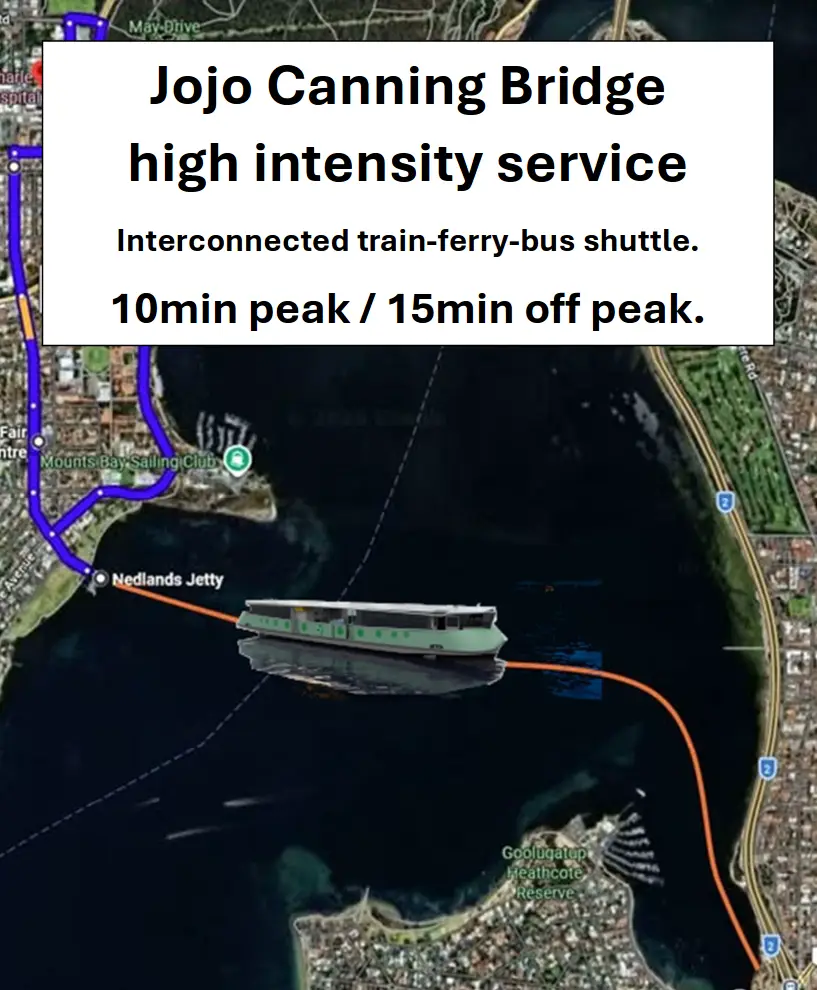
A simple Canning Bridge–JoJo’s shuttle could be designed around the existing Mandurah Line timetable, with a 15-minute off-peak ferry service and a 10-minute peak service.
Damien Smith ·
23 September 2026
The alternative vessel
I was a tenderer for PTA250023, the design and construction of the new electric passenger ferries.
My submission included an Alternative Offer based on a lower-speed, double-ended electric ferry designed specifically for the Swan River.
The vessel was intended to operate at about 10.5 knots. Being double-ended, it could arrive at a terminal and depart again in the opposite direction without having to turn around.
One possible application is a direct shuttle across Melville Water between Canning Bridge and JoJo’s, at the southern end of Broadway.The water distance is approximately 4.3 km Using the alternative vessel, a reasonable working allowance is about 14 minutes berth to berth.
Put the interchange at Canning Bridge
Instead of locating the ferry terminal at Applecross and asking passengers to make their way between the ferry and the railway, the ferry could interchange directly with the Mandurah Line at Canning Bridge. The ferry timetable could then be designed around the train timetable.
Current Transperth timetables show a basic 15-minute off-peak pattern on the Mandurah Line through Canning Bridge.[i]
During peak periods, through Mandurah services operate at approximately 10-minute intervals, with additional Cockburn services interleaved between them.[i]
That suggests two natural ferry frequencies:
Off peak: 15 minutes
A 15-minute ferry service would match the basic 15-minute off-peak Mandurah Line timetable.
A possible vessel cycle is:
- 7 minutes at Canning Bridge for train interchange and charging
- 14 minutes Canning Bridge to JoJo’s
- 10 minutes at JoJo’s for passenger interchange and timetable recovery
- 14 minutes JoJo’s to Canning Bridge
Total cycle time: 45 minutes. Three ferries would therefore provide a 15-minute service.
The seven-minute Canning Bridge dwell could be positioned around the train movements.
For example, the ferry could arrive shortly before the southbound train departs and remain until shortly after the northbound train from Mandurah arrives.
Passengers travelling south could transfer from ferry to train, while passengers arriving from Mandurah, Cockburn, Murdoch and Bull Creek could transfer from train to ferry.
The vessel could also charge during the same seven-minute stop. With an automated charging connection, charging becomes part of the normal passenger interchange rather than an additional timetable activity.
Peak: 10 minutes
If the Government’s forecasts of substantial ferry demand are correct, additional capacity could be provided during the peaks.
The current Mandurah Line timetable includes through Mandurah services at approximately 10-minute intervals during peak periods, with additional Cockburn services between them.[i]
A 10-minute ferry timetable could therefore be aligned with the through Mandurah trains.
A possible peak operating cycle is:
- 7 minutes at Canning Bridge for passenger interchange and charging
- 14 minutes Canning Bridge to JoJo’s
- 5 minutes at JoJo’s
- 14 minutes JoJo’s to Canning Bridge
Total cycle time: 40 minutes.
Four ferries would provide a 10-minute service.
This would allow the ferry timetable to be aligned with the 10-minute through Mandurah train pattern. The additional Cockburn services would provide further connection opportunities.
UWA and QEII connections
JoJo’s should not be considered simply as a ferry terminal from which passengers would be expected to walk across the university.
The existing public transport network already circulates buses between UWA, Broadway and QEII. The Purple CAT currently serves UWA and QEII, while other Transperth services also connect the university and medical centre.[ii]
A connecting bus could therefore operate from JoJo’s through UWA South, the Business School, central and northern UWA and QEII.
The bus timetable could be synchronised with ferry arrivals and departures in the same way as the ferry is synchronised with the trains at Canning Bridge.
The comparison matters because the Government’s own operating concept is still unsettled.
The ferry project was originally promoted around much higher service frequencies. Current material points instead towards approximately 25 minutes with speed exemptions, or closer to 30 minutes at existing river speed limits.
The JoJo’s–Canning Bridge concept takes a different approach. Rather than trying to recover timetable time by making the ferries faster, it shortens and simplifies the ferry route and uses Canning Bridge as the interchange with the Mandurah Line.
That potentially gives passengers a 10-minute peak and 15-minute off-peak ferry service while remaining within existing river speed limits.
It also changes what is being compared. This is not simply JoJo’s versus Matilda Bay as two places to put the same wharf. It is one complete transport system against another: train, ferry, bus, vessel, route, timetable and charging infrastructure.
The question is therefore straightforward:
Has Government modelled this as a complete public-transport alternative and compared it with the system now proposed for Matilda Bay?
About the author
Prepared by Damien Smith, Perth naval architect and Director of Damien Smith Design Pty Ltd.
Disclosures: Damien Smith Design was a tenderer for the Swan River ferry project and submitted both a conforming offer and an Alternative Offer. Damien is also a member of the Management Committee of Mounts Bay Sailing Club and a member of the Australian Labor Party. These interests are openly disclosed.
The views expressed in this note are Damien Smith’s own and do not represent Mounts Bay Sailing Club, the Australian Labor Party, or any other organisation.
This note draws on publicly available Transperth timetable information and Damien Smith Design’s own alternative vessel and operational modelling.
Sources and supporting documents
[i] Transperth, Mandurah Line timetable. Current timetable information shows the basic off-peak service pattern through Canning Bridge and the more frequent peak pattern, including through Mandurah and interleaved Cockburn services.
[ii] Transperth, University and TAFE Services and CAT timetables. Current services include Route 950, Route 97 and the Purple CAT serving UWA and/or QEII.
[iii] Damien Smith Design, PTA250023 Alternative Offer. Alternative double-ended electric ferry developed for lower-speed operation on the Swan River, with reduced turning and charging requirements.