
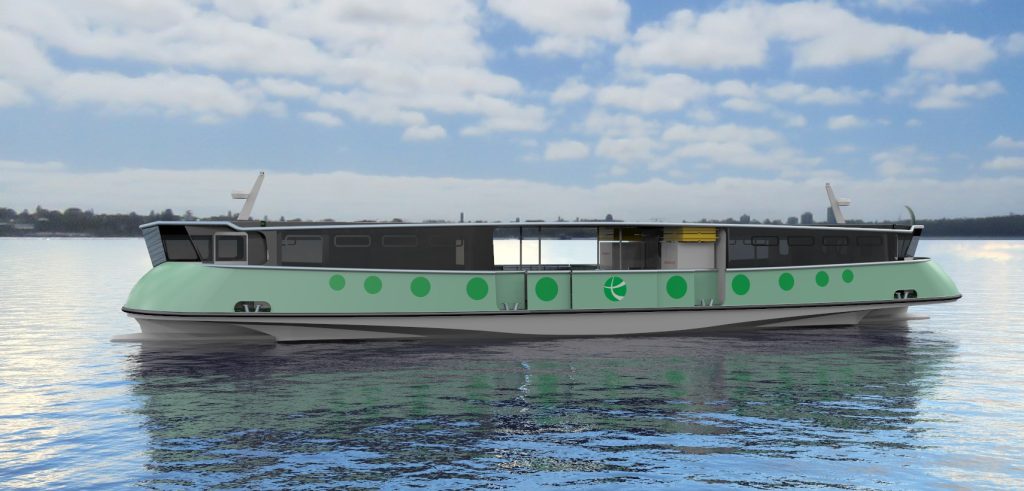
Low-Impact Electric Ferry Concept for the Swan River: A System Approach
This concept explores an alternative approach to electric ferry operations on the Swan River, where shallow water conditions, existing river use, and infrastructure constraints are key drivers.
Rather than optimising individual elements in isolation, the concept considers vessel design, operations, charging, and terminal infrastructure as a single system. The aim is to understand how these components can be balanced to achieve a workable transport outcome while minimising impact on the river environment and supporting safe coexistence with other users.
Hull Form, Propulsion and Manoeuvrability
The hull form was developed using CFD to minimise wake generation in shallow water. The design prioritises low-impact operation at moderate speeds, reducing potential effects on shorelines, seagrass, and other river users.
Timetable performance is achieved through manoeuvrability rather than speed. A double-ended configuration removes the need for turning manoeuvres at terminals, reducing propeller wash, limiting interaction near shore, and minimising required operating space.
Azimuthing nozzle thrusters provide high thrust at low speeds and precise control, supporting safe operation in active waterways and around vulnerable users including swimmers, rowers and small craft.
Operations, Charging and Infrastructure
Vessel operations, charging strategy, and terminal design are treated as an integrated system.
The concept is based on limiting peak power demand by scaling the vessel and energy requirement such that multiple journeys can be undertaken within a single charging cycle. This avoids reliance on high-power, short-duration opportunistic charging during operations and instead allows charging to occur in a predictable and scheduled manner outside peak service periods.
As a result, dependence on large electrical connections is reduced, along with the need for shore-side energy storage and other infrastructure that can introduce complexity, cost, and operational constraints.
Terminal infrastructure is based on a modular floating pontoon with integrated charging. With relatively modest electrical demand, this approach allows infrastructure to be relocated or reconfigured as required, supporting staged deployment and system evolution without committing to fixed, high-impact installations.
Cost, Risk and Buildability
By combining low-impact vessel performance, high manoeuvrability, and a reduced peak power requirement, overall system complexity and cost can be reduced relative to high-power, fixed-terminal approaches.
Avoiding reliance on short-duration, high-power charging reduces the need for large electrical connections, shore-side energy storage, and associated grid upgrades. These elements are typically major cost drivers and can introduce additional technical and delivery risk.
Systems selection is deliberately conservative, prioritising constructability, certification, and long-term operational reliability over highly optimised or novel solutions.
This approach also reduces operational and safety risk in highly utilised waterways, where vessel speed, manoeuvring requirements, and charging constraints must be managed alongside existing users. In this context, system design must support reliable operation without displacing established activities or reducing the margin for safe interaction between users.