
Community Briefing Note 08
The Development Application does not contain the full wake picture
METRONET on Swan Ferry Expansion
Date: 19 September 2026
Author: Damien Smith
The Development Application contains a substantial amount of material about ferry wake. Significantly, Government is seeking exemptions from existing speed limits that also serve to limit wake impacts from large vessels.
However, the Development Application does not contain all of the wake work Government has commissioned, received or subsequently shown to stakeholders.
For the avoidance of doubt, I make no allegation of impropriety against any person or organisation involved in preparing or publishing the Development Application. My concern is narrower: whether the material presently available is sufficiently complete to allow the wake impacts of the proposed ferry to be properly assessed.
In my professional opinion, it is not.
The wake issue was raised before tender
In November 2024 I made a written submission to the Ferry Service Expansion Project in my professional capacity as a naval architect.
I specifically raised wake and shallow-water effects and recommended that vessel and route optimisation be undertaken together with CFD modelling. My submission warned that shallow-water effects would feed directly back into the selection of vessel speed and length.
I did not receive a substantive response on the technical issue. Government commissioned a vessel-specific wake analysis from Incat Crowther.
The Incat Crowther report
The Incat Crowther wake report was not provided to tenderers during the subsequent vessel procurement. Its existence was not disclosed through the tender documentation.
I became aware that this work existed because conclusions from it began appearing in discussions with stakeholders while the procurement was still underway.
I asked to see the analysis during the tender process. That request was refused, and I was advised that the material was Cabinet-in-confidence. Stakeholders also sought the underlying technical work and received the same reason for refusal.
I have therefore never seen the complete Incat Crowther report.
Stakeholders Meeting — 26 July 2025
A number of people reading this were present at the stakeholder meeting on 26 July 2025 and will have their own recollection of what occurred.
Government representatives showed us a graphic comparing predicted ferry wake with naturally occurring wind waves. The message was clearly intended to be reassuring: ferry wake was presented as relatively modest compared with waves already occurring on the river.
The graphic received a distinctly sceptical response in the room, including laughter. Substantially the same comparison has now appeared in the Development Application as Figure 13.
I asked specifically about transcritical wake and about the importance of wave period rather than simply comparing wave height.
A senior Government representative responded by invoking the authority of another professional in the field suggesting, in substance, that because I was disagreeing with that expert I must therefore be incorrect.
The Development Application now shows that the underlying wake analysis was actually Incat Crowther’s work, while the expert had been asked to review it. That review raised significant qualifications, including that vessel wakes can be similar in height to extreme wind waves but have much longer periods and therefore much greater energy per wave — essentially the point I was making in the room. So the expert being invoked to dismiss stakeholder questions was not the author of the analysis; he was reviewing it, and his review raised similar concerns.
A very short primer on shallow-water wake
For many people reading this, this will not be the first time they have heard me talk about shallow-water hydrodynamics. For others it may be their first exposure.
A useful analogy: think of the familiar example of an opera singer hitting just the right note and causing a wine glass to vibrate strongly enough to break. It is not a perfect analogy, there are some additional quirks with water waves, but it is a useful way of thinking about the problem.
The characteristic speed of waves in shallow water depends strongly on water depth.
A vessel also has a characteristic relationship between speed and vessel length — the familiar idea of “hull speed”.
When vessel speed, vessel length and shallow-water wave speed line up badly, wake can increase dramatically.
The graphic below is from a report I prepared for stakeholders and also supplied to PTA through the tender process. The central diagram comes from work by Cox and Macfarlane at the Australian Maritime College; around it I have shown CFD cases representative of the proposed ferry.
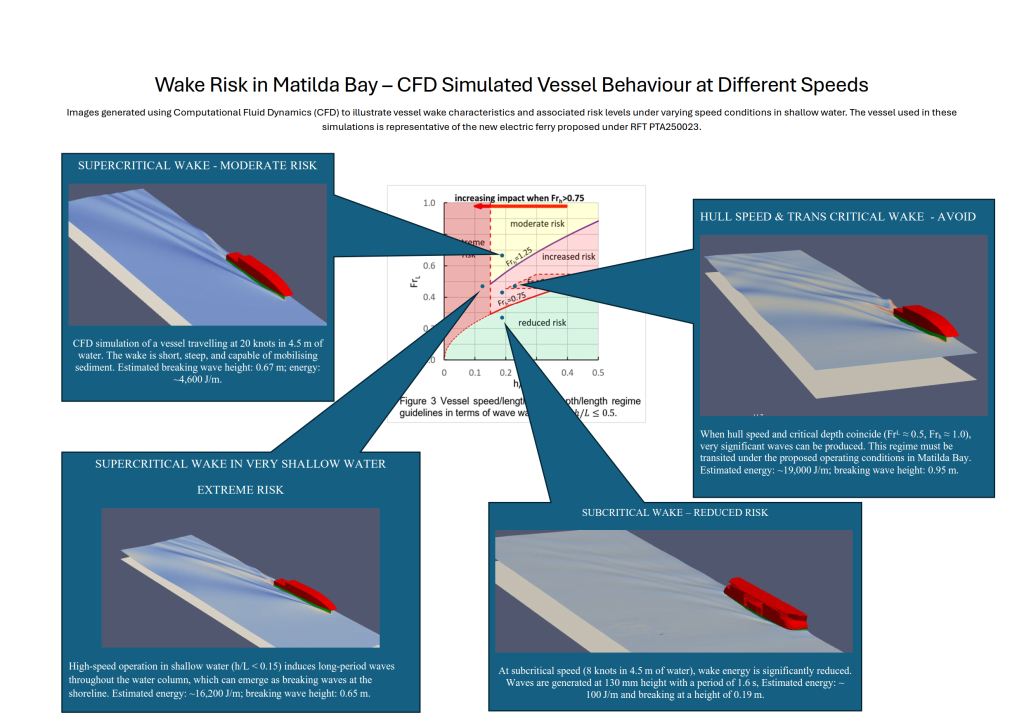
The important point is that, rather than being designed to operate cleanly on one side or the other of this troublesome combination of speed and depth, the proposed ferry has to accelerate through it during every operating cycle.
July 2026 — more detailed work shown to stakeholders
At the dedicated wake presentation in July 2026, stakeholders were shown substantially more detailed technical work than we had previously seen.
Critically, that analysis appears to present a much less reassuring picture of vessel operations, and it is not included with the Development Application upon which Government is now seeking comment.
I know that stakeholders asked for the result at approximately 12.2 knots in four metres of water, close to the shallow-water critical condition.
It was not provided. The explanation I have seen was that the ferry would pass through that speed only briefly while accelerating or decelerating and it was therefore not regarded as a typical operating condition.
That is precisely the issue: the transient condition is potentially the worst condition.
Acceleration across transcritical speed is now acknowledged as problematic
The Development Application now acknowledges the problem of transcritical wake and acceleration.
In modern design this is preferably dealt with at the planning stage: change vessel speed or length, or plan the route so that troublesome transitions occur where the resulting waves have sufficient room to dissipate harmlessly.
As I see it, PTA is now having to work out how to manage this with the vessel and system design already substantially locked in.
There is no clearly articulated operational solution beyond passing efficiently through the troublesome 12–16 knot range, with work deferred to trials after the vessels have been built.
The question for Government is:
Can Government identify an operational solution which meets both the timetable requirements and the transcritical wake constraints?
Seashore Engineering
The Development Application includes a report by Seashore Engineering. I think it would be easy for a general reader to give this report more weight than it deserves.
-
- The validation material is validation of the wind-wave model, not the ferry-wake model. Seashore’s wake calculation is not validated against measured ferry wake.
-
- The basin-wide wake result is not a new hydrodynamic simulation of the selected ferry. AMC supplied updated wake height, period and energy at 60 metres. AMC did not provide decay functions, so Seashore curve-fitted decay relationships from the earlier Incat Crowther results and applied those to the AMC numbers.
-
- Seashore says it did not critically review the differing AMC and Incat Crowther methodologies before combining them. That is significant when the underlying Incat Crowther report has still not been made available for scrutiny.
-
- The Wave C treatment is particularly odd. Incat Crowther provided no Wave C results. Seashore says Wave C increases markedly between 20 and 25 knots, but uses the decay relationship for the below-12-knot Wave B to represent the 25-knot Wave C because the initial wave heights were similar. Similar height does not establish similar period, energy or propagation behaviour.
-
- The wake source calculations use a representative 4.5 metre water depth and steady-state vessel operation. They therefore do not directly model the ferry accelerating and decelerating through the changing water depth that controls the transcritical effect.
-
- The interpolation also concerns me. If the source calculations do not adequately resolve the sharp transcritical peak, an interpolation scheme can simply smooth its way across it. If the source data do not capture the peak, curve fitting cannot put the missing physics back in.
If I were writing this as a formal engineering report, I would describe some of these as unvalidated proxy assumptions which undermine the utility of the report.
For a community briefing note, the plainer translation is: they’re basically vibing their way through it.
The information needed to assess wave effects has not been provided
This is not really an argument about whose model should be preferred. It is about whether the people being asked to assess the consequences of the project have been given enough information to do so.
There is a reasonably dry engineering term for this: engineering assurance. In plain English, that is the work needed to establish that the engineering is right before decisions rely on it: checking assumptions, testing adverse cases, reviewing calculations, verifying results, validating models against measurements where appropriate, and allowing effective technical challenge. On this project, important reports have not been released, difficult operating cases have been omitted or difficult to obtain, more detailed work shown to stakeholders is absent from the Development Application, key wake predictions rely on proxy assumptions that have not been validated for the selected ferry and operating case, important operating parameters remain unresolved, and some of the remaining hydrodynamic questions are being deferred to trials after the vessels have been built. None of those things individually proves the engineering is wrong, but taken together they are precisely the sort of warning signs engineering assurance is intended to address.
Government should publish the complete wake record, including the Incat Crowther report, the AMC work, the more detailed material presented to stakeholders in July 2026, the Seashore input data and interpolation methodology, and the results of properly instrumented wake trials.
People cannot be expected to assess accurately what this project will mean for them if they are not given the information and the time required to understand it.
More fundamentally, the accumulating technical problems and the way they have been dealt with raise a larger question:
Should Government continue trying to make this particular vessel, route and operating concept work at all?
About the author
Prepared by Damien Smith, Perth naval architect and Director of Damien Smith Design Pty Ltd.
Disclosures: Damien Smith Design tendered for the Swan River ferry project and submitted both a conforming offer and an Alternative Offer. Damien is also a member of the Management Committee of Mounts Bay Sailing Club and a member of the Australian Labor Party.
These interests are openly disclosed. The views expressed here are Damien Smith’s own.