
Community Briefing Note 11 — Just put lanes on the river?
METRONET on Swan Ferry Expansion
Damien Smith — 10 October 2026
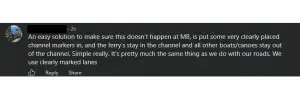
Someone suggested recently that the answer to the ferry safety problem is pretty simple:
“Put channel markers in, make the ferries stay inside them, and keep all the other boats and canoes out.”
The interesting bit is that this is increasingly close to where the Government’s own thinking seems to be heading.
The current Development Application talks reassuringly about a primary ferry route, with alternative routes used for different river conditions, events, wildlife and safety issues. In other words, there will be places where the ferry goes, and places where it doesn’t, depending on what else is happening.
That sounds sensible until you think about what is required to make it work.
If other users are prohibited from entering a defined ferry corridor, you are effectively talking about a closed-water or exclusion-zone arrangement.
If different types of traffic are deliberately separated onto different routes at different times, that starts to look like the logic behind a traffic separation scheme.
Neither is just “put some buoys in”.
And once the ferry route itself changes depending on what activity is happening on the river, there is another problem:
Who manages all of this?
A Vessel Traffic Service, or VTS, is the formal maritime version of this idea. VTS systems are normally used in major ports, congested waterways and environmentally sensitive areas. They exist because getting vessel traffic management wrong can have fairly serious consequences — think ships running into each other or supertankers ending up on the rocks.
If Government wants to do three things at once —
- maintain a reliable high-frequency ferry timetable;
- allow all the existing recreational activities to continue; and
- move the ferry between different routes depending on what is happening on the water —
then some form of active vessel traffic management starts to look unavoidable.
Think the Port Hedland control tower.
Obviously, a VTS is a high-cost intervention. We normally justify that sort of system because the harm we are trying to prevent is also very large — an oil spill on the Great Barrier Reef, a ship collision inside a major harbour, or a port being shut down for days.
You would not normally build one to stop a ferry running into a capsized windsurfer or a couple of teenagers in a rowing shell.
But this is where the economics of safety gets uncomfortable.
Shutting down a major port might cost millions of dollars. There is similarly no convenient dollar value to put on channelling the youthful energies of a couple of grumpy, hormonal teenagers into sport and keeping them safe. Unless, of course, they are your grumpy, hormonal teenagers, in which case going to war to keep them safe seems perfectly reasonable.
The governance problem
This is really just another example of the governance problem that has run through the project from the beginning.
Marine expertise and the practical knowledge of existing river users have largely been corralled into a well-insulated stakeholder-consultation process rather than being central inputs to the design of the transport system itself.
At times it feels as though the project was developed by bus drivers and property developers, although I am sure Government had some appropriately qualified consultants helping along the way.
The result is that, after vessels have been ordered and construction has commenced, Government still cannot clearly articulate a feasible operating system to make the whole thing work: the final route, the speed regime, the timetable, the interaction with sailing and rowing, and the controls required to manage conflicts on the water.
Even the published summaries of the Business Case and Multi-Criteria Analysis contain obvious flaws, while the underlying documents remain unpublished.
From a project-governance point of view, this is an extraordinary folly.
The taxpayer is being asked to take a roughly $500 million, 30-year bet on this transport system, while Government still cannot show a clear pathway from the hardware it is buying to the positive social and economic benefits being claimed for the project.
There is nothing unusual about leaving some questions to detailed design. If the broad system is sound and there are several credible ways of resolving a particular issue, working through those options later is perfectly normal project development.
This is different.
The unresolved questions go to the operating system itself: the route, speeds, timetable, interaction with existing river users, charging strategy and the controls needed to make it all work safely.
Government is pushing ahead with construction without yet demonstrating a feasible pathway through those problems.
That is not detailed design. It is kicking fundamental project questions down the road after the money has been committed.
It is also a rather elaborate game of pass the parcel with the costs and harms.
The Minister has acknowledged, on ABC Radio, that there are risks. The question is who ultimately gets to eat them.
One possible outcome is that the operating system simply does not work as promised and we end up with a very expensive fleet of ferries spending rather more time tied to a wharf than anyone intended.
Another is that the system is made to work by progressively restricting the activities that already happen on the river. In that case the cost is carried by the people who lose access, amenity or activities that matter to them.
That may include a couple of grumpy, hormonal teenagers who might otherwise have had their youthful energies channelled into sport rather than something considerably less useful.
The Government’s own Waterways Stakeholder Reference Group minutes make this unusually explicit:
“vessel scheduling will be determined through further consultation, planning and operational testing once the vessels have been constructed.”
About the author
Prepared by Damien Smith, Perth naval architect and Director of Damien Smith Design Pty Ltd.
Disclosures: Damien Smith Design was a tenderer for the Swan River ferry project. Damien is also a member of the Management Committee of Mounts Bay Sailing Club and a member of the Australian Labor Party.
The views expressed in this note are Damien Smith’s own and do not represent Mounts Bay Sailing Club, the Australian Labor Party, or any other organisation. This note is based on publicly available information.
← Previous: Community Briefing Note 10 · View all briefing notes · Next →